

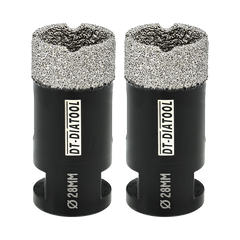
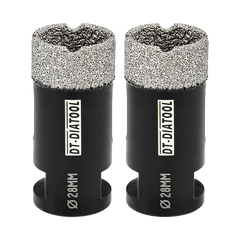
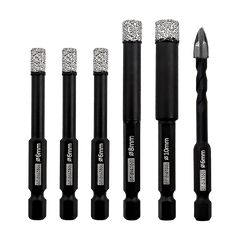
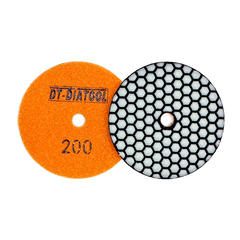


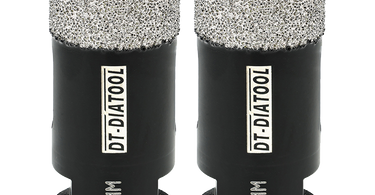
Choosing the right diamond drill bit involves more than selecting the correct hole diameter. The connection between the bit and the machine must also match. A threaded diamond core bit designed for an angle grinder will not automatically fit a standard hand drill, even if both tools can perform similar drilling tasks.
Two common threaded connections are M14 and 5/8"-11, while diamond drill bits designed for hand drills often use a round, hex, or other compatible shank. Understanding these connection types helps you choose the right bit, avoid incompatible accessories, and reduce the risk of damaging your equipment.
This guide explains how to identify your machine's connection, compare the most common thread sizes, and select the right diamond drill bit for your application.
1. M14 vs. 5/8"-11: Understanding Threaded Diamond Drill Bits
M14 and 5/8"-11 are threaded connections commonly found on diamond core drill bits and other accessories designed for compatible angle grinders or drilling equipment. Although they serve a similar purpose, their dimensions and thread profiles differ.
What Is an M14 Thread?
M14 refers to a metric thread with a nominal diameter of 14 mm. A standard coarse M14 thread has a pitch of 2.0 mm, although the exact specification should always be confirmed.
M14 diamond drill bits are widely used with compatible angle grinders in many international markets, particularly in Europe and Asia.
Typical applications include drilling holes in porcelain tile, ceramic tile, marble, granite, and other materials, depending on the bit's design and operating specifications.
Before purchasing an M14 diamond drill bit, check that your machine has the correct M14 connection and that the bit is rated for the machine's operating speed and intended application.
What Is a 5/8"-11 Thread?
The 5/8"-11 connection is an inch-based Unified National Coarse (UNC) thread commonly found on compatible angle grinders and diamond drilling accessories in North America.
Its nominal diameter is 5/8 inch, or approximately 15.875 mm, and the thread has 11 threads per inch.
Although M14 and 5/8"-11 may look similar at first glance, they are not interchangeable. Their nominal diameters and thread pitches differ, so a bit designed for one connection should not be forced onto a machine with the other.
M14 vs. 5/8"-11: Key Differences
| Feature | M14 | 5/8"-11 |
|---|---|---|
| Measurement system | Metric | Inch-based |
| Nominal diameter | 14 mm | 5/8" (15.875 mm) |
| Thread pitch | 2.0 mm for standard coarse thread | 11 threads per inch |
| Common application | Compatible angle grinders and accessories | Compatible angle grinders and accessories |
| Interchangeable? | No | No |
The most reliable way to identify the correct thread is to check the machine manual, manufacturer's specifications, or the markings on the spindle. A caliper and thread-pitch gauge can help verify the measurements when the specifications are unavailable.
Important: Do not identify a thread solely by its apparent diameter. The pitch, thread profile, connection direction, and machine compatibility must also match.
2. What Is a Shank Diamond Drill Bit?
Unlike a threaded diamond drill bit that screws onto a compatible spindle, a shank diamond drill bit has a stem that fits into a drill chuck or a dedicated tool holder.
Shank-mounted diamond drill bits are commonly used with standard hand drills and other compatible drilling equipment. They are especially useful for smaller holes in materials such as ceramic tile, porcelain, marble, and granite, depending on the bit's design.
The most common shank types include round shanks and hex shanks. Other configurations, such as SDS-Plus, are designed for specific tool holders and should not be confused with ordinary drill-chuck shanks.
Round Shank
A round shank has a cylindrical profile and is designed to be clamped by a compatible drill chuck.
Round-shank diamond drill bits are a common choice for standard electric drills and cordless drills. They are suitable when the chuck can accommodate the shank diameter and clamp it securely.
Before buying, confirm the shank diameter and the chuck's clamping range. A shank that is too large will not fit, while an improperly clamped shank may slip during drilling.
Hex Shank
A hex shank has six flat sides and fits compatible drill chucks or hexagonal holders.
Its flat surfaces can help the chuck or holder transmit torque and resist slipping. Hex-shank diamond drill bits are available for various drilling applications, including smaller holes in tile and stone.
However, a hex shank does not automatically fit every impact driver or drill. Check the shank dimensions and holder compatibility, and use only tools approved for the bit.
SDS-Plus Shank
SDS-Plus is a dedicated insertion system used with compatible rotary hammers. It is not the same as a round or hex shank, nor is it a threaded connection such as M14 or 5/8"-11.
Some diamond drilling accessories are available with SDS-Plus connections, but compatibility depends on the specific bit and machine.
Never use hammer action with a diamond drill bit unless the manufacturer explicitly permits it. Conventional diamond hole saws and core bits generally require rotary drilling without impact. Hammering can damage the diamond segments or the workpiece.
3. Threaded Diamond Drill Bits vs. Shank Diamond Drill Bits
The main difference is how the bit connects to the machine. This determines which accessories you can use and what you need to check before purchasing.
| Feature | Threaded Diamond Drill Bit | Shank Diamond Drill Bit |
|---|---|---|
| Typical connection | M14 or 5/8"-11 | Round, hex, or a dedicated shank |
| Common machine | Compatible angle grinder or threaded spindle | Compatible hand drill or dedicated tool holder |
| Installation | Screws onto a matching threaded connection | Clamps into a chuck or inserts into a compatible holder |
| Main compatibility check | Thread diameter, pitch, and connection type | Shank profile, diameter, and chuck or holder capacity |
| Typical use | Tile and stone drilling with a compatible threaded tool | Tile and stone drilling with a compatible drill |
The distinction is important because the machine's connection determines which bit you can install, not simply the material you want to drill.
For example, an M14 diamond core bit will not fit directly into a standard drill chuck. A round-shank diamond drill bit, on the other hand, will not screw directly onto an M14 spindle.
4. How to Choose the Right Diamond Drill Bit for Your Machine
Before placing an order, follow these steps to confirm compatibility.
Step 1: Identify Your Machine Type
Start by identifying the tool you plan to use.
If you are using an angle grinder, check whether its spindle is M14, 5/8"-11, or another specified connection.
If you are using a standard hand drill or cordless drill, check the chuck type and its clamping range. You will usually need a compatible shank drill bit.
For a rotary hammer or specialized core drill, consult the machine manual to identify the correct holder or spindle connection.
Do not assume that all machines from the same brand use the same connection. Specifications can vary between models and regional versions.
Step 2: Check the Bit Connection
Once you have identified the machine interface, compare it with the bit specifications.
For a threaded bit, confirm the complete thread designation rather than relying on the diameter alone.
For a shank bit, check the shank shape and dimensions. A 10 mm hex shank, for example, will not fit into a chuck whose maximum capacity is smaller than 10 mm.
If the connection is not clearly labeled, ask the supplier to confirm the specifications before ordering.
Step 3: Match the Bit to the Material
The correct connection does not guarantee that the bit is suitable for the job.
Check the manufacturer's material recommendations and operating instructions. Diamond drill bits designed for porcelain tile may differ from those intended for granite, marble, concrete, or other materials.
Also consider the hole diameter, drilling depth, cooling requirements, and recommended speed. For many small diamond hole saws, a stable starting position and controlled pressure help reduce wandering and edge chipping.
Step 4: Check Operating Speed and Drilling Mode
Different machines operate at different speeds, and not every diamond drill bit can be used safely at the maximum speed of an angle grinder.
Verify the bit's rated maximum RPM and the machine's operating speed before installation. If the machine runs faster than the bit permits, do not use that combination.
For diamond drilling, use the drilling mode specified by the manufacturer. Unless the product is explicitly designed for impact drilling, turn off hammer mode.
For dry drilling, follow the product's cooling instructions and allow appropriate pauses to control heat and remove drilling debris. For wet drilling, use a bit and machine setup designed for wet operation, with suitable electrical and water-safety precautions.
5. Can You Use an Adapter to Fit a Different Connection?
In some cases, an adapter can connect a threaded diamond core bit to a compatible hand drill or allow a compatible accessory to fit a different spindle thread.
For example, adapters are